
From Waste to Worth: How Community Action is Revolutionizing Food Sustainability
Blog by Tamy Seguiya Ohls
Food waste is a global challenge, impacting both affluent and developing nations. Each year, staggering amounts of food are discarded while countless individuals worldwide grapple with hunger and food insecurity. A 2021 UNEP report highlighted this issue, revealing that approximately 931 million tons of food were wasted in 2019. Most of this waste occurred in households (61%), followed by food services (26%), and retail (13%). This means about 17% of the total global food production was potentially discarded, with 11% from households, 5% from food services, and 2% from retail (UNEP 2021).
In response to this pressing issue, food banks have emerged as an incredible and innovative solution, bridging the gap between food waste and human needs. These vital institutions ensure that food that would otherwise be discarded reaches those who truly need it. This insightful approach efficiently tackles food waste while simultaneously helping to alleviate hunger in local communities.
Incorporating sustainability into social actions goes beyond simple environmental practices; it’s rooted in a broad understanding of how our initiatives interconnectedly affect the environment, society, and the economy. By adopting a holistic approach, our goal is to find a balance between environmental, social, and economic dimensions, thereby contributing to the creation of more resilient and equitable communities. This integrated approach means considering not only environmental impacts but also social aspects like equity and inclusion, and economic ones such as sustainable development and decent employment. Thus, we’ve learned that sustainability isn’t just an isolated practice but a mindset and a way of living that seeks to harmonize different elements to promote a more balanced and healthy future for all. A holistic understanding of sustainability in social actions implies empowering communities to actively participate in building a more balanced future where human well-being, environmental preservation, and economic development coexist harmoniously.
In Lisbon, I was part of a volunteer service where community members have united to break the cycle of food waste. This volunteer initiative not only prevents food waste but also provides nourishment to those most in need. Inspired by this, I chose to explore the theme of social initiative and food sustainability for this project, aiming to understand how voluntary actions and community involvement can play a crucial role in creating more sustainable and equitable food systems.
Refood: A Simple Idea with Transformative Impact
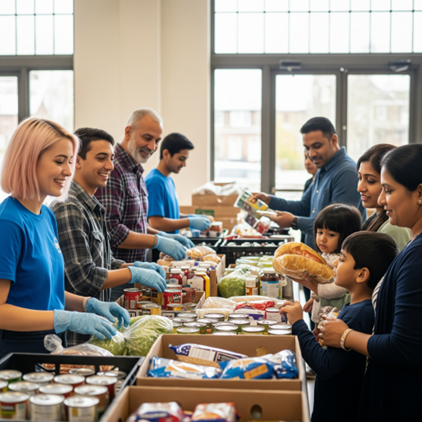
Refood is a Portuguese NGO dedicated to combating food waste and hunger in local communities. Refood organizes volunteers to collect food that would otherwise be discarded by establishments like restaurants and supermarkets, then distributes it to people facing hardship. What makes it special is its community-based approach, involving residents as volunteers who actively participate in food collection and distribution. Beyond reducing waste, Refood strengthens bonds of solidarity among community members. The simplest idea, it turns out, can have a transformative impact.
In 2011, Hunter Halder, an American who had been living in Portugal for two decades, questioned the discrepancy between people experiencing hunger and restaurants wasting food. Driven by this question, he decided to act. The association that resulted from this impulse was born. Hunter Halder began his first food collection from cafés and restaurants, navigating the streets on his bicycle. The simplicity of the idea, it turned out, was entirely feasible. Hunter Halder shared his initial approach, studying the area and identifying 285 potential donors. However, he faced a logistical challenge, questioning how he would do this by bike and realizing it wouldn’t be possible. He then began to restrict, reducing the size of the area, but it still wasn’t feasible. He continued cutting until he was left with seven blocks and 45 food sources. He observed closing times, divided the work into two shifts, and affirmed that it was possible. He started contacting the cafés and restaurants in the area. Out of 45 establishments, 30 agreed to participate in the initiative. His initial approach was with Carlos, the owner of the pastry shop across from his house. He asked if there were any leftover items at the end of the day that would go to waste, and Carlos explained that he had few lunch leftovers, like soup, bread, and some pastries. So, it was proposed that when he passed by at the end of the day, Carlos would provide whatever was left. He agreed, even if it was a small quantity. With the first adhesion guaranteed, the process was repeated at the other establishments. Many raised objections, claiming there was little left, and it wasn’t worth it, but he persisted, defending the idea that it was worth salvaging food destined for the trash. In the end, all 30 establishments were convinced to participate in the initiative (Coelho 2014).
Across Portugal, over 60 local centers are active, dedicated to serving the needs of their communities. Each local Refood hub plays a crucial role in rescuing food, feeding people, and involving the community in this collective mission that benefits everyone. Anyone interested can propose the creation of a Refood hub, mobilizing friends, family, and community members. After contacting Refood (National or Global), a Refood Pioneer Team can be formed to begin small-scale food collection, delivering to partner institutions, and publicizing the work on social media. The Pioneer Team is responsible for inviting the community to participate, holding public meetings to recruit volunteers, and researching the neighborhood where they will operate. The team organizes internally, develops its action plan, and continues to rescue food to feed those in need, documenting their work. Subsequently, the team chooses an operations center, executes its plan, invites partners to help remodel the space, acquires, and installs necessary equipment, and identifies and invites nearby food sources. After the inauguration of the operational center, the team continues to engage partners and beneficiaries, plans training sessions, holds a second public meeting to attract new volunteers and partners, and defines the inauguration day and full-service start. The team is formed, online and in person, and the community is invited to the public inauguration.
Volunteers are organized into management groups, composed of a team of volunteers divided into five specific areas of activity. Each group is dedicated to a distinct folder: volunteers, beneficiaries, operations, community funds, and leadership. Leadership, in turn, coordinates all these areas to ensure effective and integrated management of activities. Route volunteers perform a series of crucial tasks for the process. Upon arrival, they sanitize their hands, put on their vests, and prepare specific bags to maintain food temperature. Then, they follow a predetermined schedule to visit different establishments, such as restaurants, supermarkets, fruit shops, and pastry shops, where they collect leftovers. Upon returning, donations are weighed, recorded with information on origin and time, and stored in the organization’s refrigerators. This careful approach ensures proper handling and preservation of the quality of rescued food. Volunteers working at the center play a vital role in the process. Upon arrival, they remove all donations stored in the refrigerators from the previous day, carefully evaluating the available food for distribution among the families served. A board with family information, including pick-up times, serves as a guide. Volunteers check for any special indications, such as specific dietary needs, for example, for diabetics. This attention to detail ensures that distribution is done in a personalized manner, prioritizing the individual needs of each family, as in the case of providing yogurts and milk for those with children.
Families are selected through a team that visits churches, parishes, Vincentian conferences, and social workers from different centers. This team asks questions to identify families signaled as needing food assistance. Various families have been indicated, interviewed, and their residences visited to verify the real need for help from Refood. This careful selection process ensures that assistance is directed to families who truly need it. Families also have the option to register on the Refood website to receive food assistance.
Community Mobilization: The Power of One
Community mobilization is a way of uniting individuals to address problematic social conditions. As an intentional collective effort, mobilization requires solid analytical, political, and interpersonal skills. A crucial element of these skills for professional organizers involves a continuous pattern of systematic planning, “putting into practice,” reflection (theorizing), and strategic action to build a group capable of achieving its goals. Community organization has its roots in the tradition of professional social work reform and in values such as self-determination, autonomy, empowerment, and social justice. Therefore, this course is particularly relevant for the direct practice and advocacy of disadvantaged groups in society, such as ethnic and racial minorities, low-income people, women, the elderly, and people with disabilities (UNIVERSITY OF MARYLAND 1999).
The Power of Individual Action and Community Mobilization
This text highlights how a single individual can spark significant change through passion, determination, and willingness to act. This individual’s initiative, in the context of the Refood project, demonstrates that seemingly small actions can lead to enormous results, expanding beyond local communities to influence an entire country and even others. This proves the transformative capacity within each person and the vital role of personal involvement and citizen action in creating positive societal impact.
Holistic Approach and Broad Impact
The Refood initiative exemplifies a holistic approach to complex social problems. By addressing food waste, supporting vulnerable families, and fostering community engagement, it shows a deep understanding of interconnected social challenges. This integrated strategy not only achieves measurable objectives such as the vast number of beneficiaries, volunteers, and meals provided, but also generates significant intangible benefits. These include strengthened social ties, community building, and positive impacts on the mental health of volunteers, as research suggests (Nichol et al. 2023). The initiative proves that every gesture, regardless of its quantitative scale, is valuable in building stronger, more supportive communities and achieving lasting positive change.
References
Coelho 2014. A ideia mais simples, afinal, era possível. Last accessed 1.6.2024 https://www.publico.pt/2014/12/28/sociedade/noticia/a-ideia-mais-simples-afinal-era-possivel-1680505
ReFood 2023. Last accessed 1.6.2024 https://re-food.org/
UNIVERSITY OF MARYLAND 1999. COMMUNITY ORGANIZATION. Last accessed 1.6.2025 https://comm-org.wisc.edu/syllabi/soifer.htm
UNEP 2021. UNEP Food Waste Index Report 2021. Last accessed 1.6.2025 https://www.unep.org/resources/report/unep-food-waste-index-report-2021
Revista Penha de França 2023. Refood, um projeto que procura voluntários. Edição 92, December 2023.
Generated by Gemini (2025) Food bank with volunteers donating food to families. Available at: http://googleusercontent.com/image_generation_content/0 Accessed: 5.6.2025.
Partners


